Picture a normal evening: you’re cooking dinner, the lights are on, the Wi‑Fi is running… and then everything goes dark.
Maybe it’s a storm. Maybe it’s “routine maintenance.” Maybe it’s just your area being pushed to the limit again.
If you’ve ever thought, “I don’t want my comfort and safety tied to a system I can’t control,” you’re already thinking in the right direction. The goal isn’t to become a full-time off-grid homesteader overnight. It’s to build a practical path toward energy independence—one step at a time—without overwhelm.
One Big Idea: Basics first, upgrades second.
In this beginner-friendly guide to How to Stop Relying on the Grid (Energy Independence 101), you’ll learn:
- How to reduce your dependence before you buy anything big
- A simple framework for off-grid power planning (even if you’re not “technical”)
- A step-by-step plan to create reliable backup power and long-term resilience
Next: a quick reality check so you can stop guessing and start making clear decisions.
Quick Reality Check
Wanting more control over your power is common—especially now. Most people aren’t “lazy” or “behind.” They’re just stuck because energy independence feels like a topic where you either go all-in… or you do nothing.
That’s not true.
Here’s what it usually looks like in real life:
- Your power bill climbs, but you’re not sure what actually moves the needle
- You think about solar panels or a generator, but the options feel confusing
- You want backup power for emergencies, but you don’t want a noisy, fuel-dependent setup
You’re not behind—you just need a simple plan.
Next: the framework that keeps you from wasting money on the wrong upgrades.
The Core Framework
If you remember only one thing from this article, remember this: energy independence is built in layers.
1) What matters most (key variables)
Before picking gear, get clear on the variables that determine what works:
- Your essential loads: what must run when the grid doesn’t (fridge, lights, medical devices, phone charging, etc.)
- Your runtime goal: hours vs. days, short outages vs. longer disruptions
- Your local constraints: sunlight, climate, space, noise restrictions, HOA rules, budget
2) The basics (core actions)
The basics are about lowering your dependence first:
- Reduce waste (so you need less power to feel comfortable)
- Identify the smallest set of “must-have” circuits/devices
- Establish a simple backup strategy for those essentials
3) The “next layer” (the upgrade people skip)
This is where most people jump too fast—and overspend:
- Planning a system that can scale
- Choosing an approach that’s realistic for your skill level
- Designing for reliability (not just “it works on a perfect day”)
Example: If your fridge, a few lights, and phone charging are your true essentials, you may not need to power your entire house to feel “secure.”
Example: If you lower your baseline usage first, any backup system—solar, battery, generator—becomes cheaper and more effective.
Next: a step-by-step plan you can actually follow without turning this into a second job.
The Step-by-Step Plan (Beginner’s Guide)
This is a practical, beginner-first approach to How to Stop Relying on the Grid (Energy Independence 101). You can do it in phases, at your pace.
Step 1: Define “power independence” for your household
Most frustration comes from a fuzzy goal. Decide what “independent” means for you—and keep it simple.
Some people want lower electricity bills. Others want outage protection. Others want an off-grid lifestyle path. You can want more than one—but pick your first target.
Checklist:
- List your top 5 “can’t-lose” items during an outage
- Decide your minimum runtime goal (e.g., overnight, 24 hours, multi-day)
- Identify who lives in the house and any special needs (pets, medical devices)
- Note your local outage patterns (seasonal storms, heat waves, rolling blackouts)
Do this now: Write a one-sentence goal: “I want to keep ___ running for ___ without relying on the grid.”
Step 2: Cut the easiest energy waste first
This is the unglamorous part—but it’s the part that makes everything else cheaper.
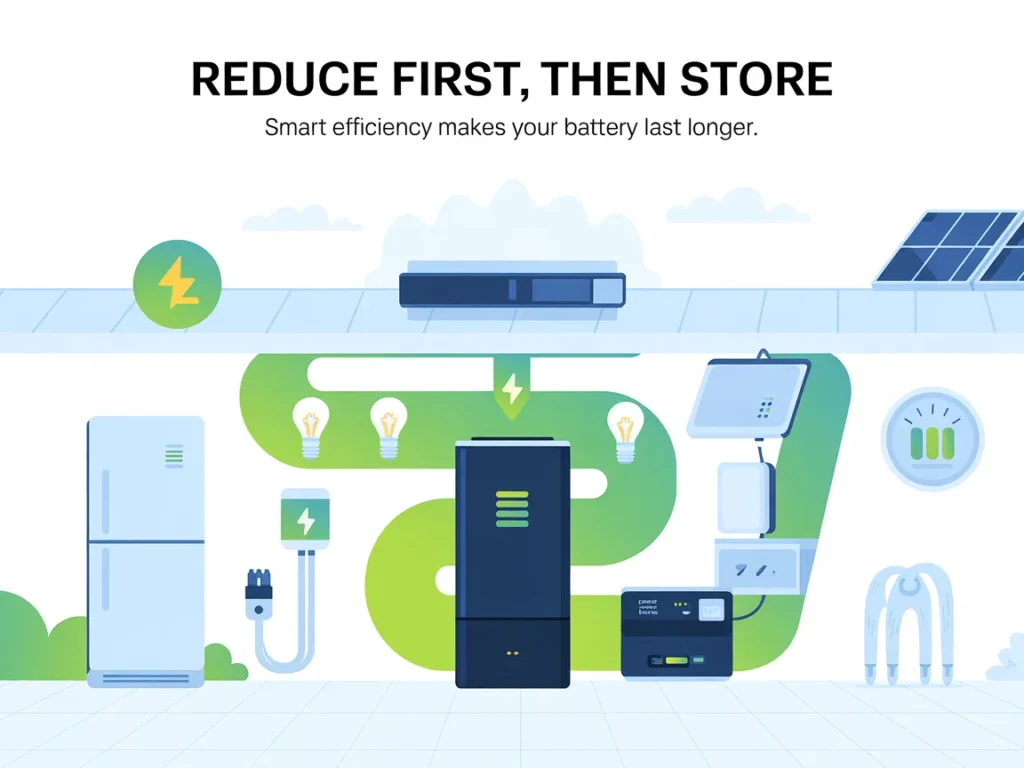
When you reduce what you need, you reduce the size (and complexity) of whatever backup power system you choose later. That’s why basics first, upgrades second is the safest way to start.
Checklist:
- Swap the most-used lights to LEDs
- Identify “always-on” devices and unplug what you don’t need
- Use smart power strips for entertainment/work areas
- Adjust thermostat habits slightly (small changes compound)
- Check weatherstripping and drafts around doors/windows
Do this now: Pick one room and eliminate its biggest “always-on” energy leak this week.
Step 3: Identify your essential loads and simplify them
Energy independence gets far easier when you stop trying to power everything.
Think in terms of “essential loads.” This is what you’ll design around for backup power, emergency preparedness, and long outages.
Checklist:
- Choose 1–2 refrigeration priorities (fridge/freezer)
- Choose a lighting plan (a few lamps or LED bulbs in key rooms)
- Choose communication power (phones, router, radio)
- Consider cooking alternatives (not everything must be electric)
- Decide if you need water support (well pump, filtration, storage)
Do this now: Make a “power during outage” list and circle only what’s truly essential.
Step 4: Choose a starter backup approach you can actually use
The best system is the one you’ll set up, test, and maintain.
For many homeowners, starting small is smarter: a reliable backup for essentials is a big quality-of-life upgrade—even before you pursue full off-grid power.
Checklist:
- Decide if your priority is quiet indoor power, portability, or whole-home coverage
- Set a “simplicity rule” (if it’s too complex to test monthly, it’s too complex)
- Consider fuel availability and storage realities if using combustion options
- Consider battery storage needs for quiet overnight use
- Think about how you’ll connect: extension cords vs. safer home integration
Do this now: Choose one starter backup direction and commit to testing it monthly.
Step 5: Design your “next layer” for long-term energy independence
Once the basics are handled, the next layer is where you build toward real independence—without accidental overspending.
This is where people start looking at renewables, energy storage, and more resilient setups. But the correct order matters: your baseline usage and essential loads determine what’s reasonable.
Checklist:
- Decide whether you want to scale toward partial or full off-grid living
- Plan for seasonal realities (short winter days, storms, heat)
- Consider redundancy (what happens if one component fails?)
- Keep maintenance simple and scheduled
- Document your setup so anyone in the household can use it
Do this now: Write down your “next layer” goal: add resilience first, add capacity second.
Step 6 (Optional): Build a calm routine for preparedness
Energy independence isn’t just gear. It’s habits.
A tested, familiar plan beats an expensive system you’ve never practiced using.
Checklist:
- Monthly test: run essentials from your backup for 30–60 minutes
- Keep a charging routine for batteries/power banks
- Store lighting options where you can reach them in the dark
- Keep a printed checklist for outages
- Review your plan before storm seasons
Do this now: Put a recurring monthly reminder to test your backup setup.
Next: the common mistakes that cause most people to quit—or spend money twice.
Common Mistakes
Trying to power the whole house immediately
Why it happens: It feels safer to “cover everything,” but it explodes complexity fast.
Simple fix: Start with essential loads; expand only after your basics are stable.Buying gear before defining runtime and priorities
Why it happens: Marketing makes everything look like the missing piece.
Simple fix: Write your must-run list and runtime goal first, then choose equipment.Ignoring energy reduction because it’s “boring”
Why it happens: Efficiency upgrades don’t feel exciting.
Simple fix: Treat efficiency like “free power” that reduces every future cost.Overcomplicating the system so it never gets tested
Why it happens: People assume more features equals more safety.
Simple fix: Choose a setup you can test monthly without stress.No plan for fuel/storage/maintenance realities
Why it happens: Backup plans look good on paper until real life shows up.
Simple fix: Pick options that match what you can store, maintain, and use calmly.Skipping documentation and household training
Why it happens: One person “knows the system,” everyone else guesses.
Simple fix: Keep a one-page checklist and walk the household through it.
Options Comparison
Here are five common approaches to **How to Stop Relying on the Grid (Energy Independence 101)**—each with tradeoffs.
Option 1: Efficiency-first (reduce usage before adding power)
Best for: Budget-conscious homeowners who want immediate wins.
Pros:
- Low cost compared to big power setups
- Reduces future system size needs
- Improves comfort and lowers ongoing waste
Cons:
- Doesn’t provide power during an outage by itself
- Results can feel incremental
Option 2: Portable battery power (small “backup power” setup)
Best for: People who want quiet emergency power for essentials.
Pros:
- Quiet operation compared to many fuel-based options
- Useful for phones, lights, small devices
- Can be part of a bigger plan later
Cons:
- Limited runtime depending on load
- Needs recharging strategy
Option 3: Fuel-based generator backup
Best for: Those who prioritize high output quickly.
Pros:
- Can power larger loads depending on generator size
- Good short-term solution for outages
- Widely available and familiar
Cons:
- Fuel storage and replenishment can be a hassle
- Noise and maintenance considerations
- Not ideal for indoor use
Option 4: Rooftop solar with battery storage
Best for: Homeowners looking for long-term resilience and partial grid independence.
Pros:
- Renewable energy production
- Battery storage can provide quiet backup
- Can reduce grid reliance over time
Cons:
- Higher complexity and planning needs
- Site-specific performance (sun exposure, seasons)
- Typically requires professional design/installation
Option 5: DIY off-grid approach (incremental system you build yourself)
Best for: DIY enthusiasts and self-sufficiency seekers who want control.
Pros:
- Flexible and scalable
- Can be built in phases
- You understand your own system deeply
Cons:
- Requires learning and careful planning
- Mistakes can cost time and money
- Takes effort to keep safe and reliable
Which option should you pick?
If you’re a homeowner who wants confidence without turning your life into a project, start with efficiency + essential-load backup. If you’re more DIY-inclined and want to build toward off-grid living, choose an approach that’s modular and testable. Your best choice depends on your time, comfort with tools/technical details, and how long you need power when the grid is down.
Next: a resource that can help you see one complete approach laid out clearly.
Resources
If you’ve been researching How to Stop Relying on the Grid (Energy Independence 101), you’ve probably noticed something: most advice is either too vague (“just get solar”) or too technical too fast.
The Energy Revolution System presentation is worth watching as a walkthrough-style resource. It’s designed to show you an organized approach you can review at home, at your pace, and decide what applies to your situation.
Even if you’re not ready to buy anything, it can be useful to see a complete explanation in one place—so you can compare it against other options and make more confident choices.
You’ll see how it works, what’s included, and whether it fits you.
SEE THE FULL PRESENTATION HERE
If you want a clearer picture of one organized system for reducing grid dependence, the next step is simply to watch the presentation and take notes on what matches your goals.
In the presentation, you’ll see:
- What the Energy Revolution System is and how it’s structured
- The core approach it teaches for building independence in a practical way
- What’s included so you can decide if it’s relevant to your home
Objection Handling FAQ
Beginner-friendly learning
Is this beginner-friendly if I’m not technical?
The goal is clarity and a step-by-step understanding. Watch the presentation first and see if the explanations feel approachable for your current level.
Do I need special tools to get started?
For the “basics first” steps (reducing waste, defining essential loads), no special tools are required. The presentation helps you understand what’s involved before you decide on upgrades.
How long does it take to become less dependent on the grid?
You can reduce dependence quickly by cutting waste and choosing essential loads. Building a longer-term system is typically done in phases.
Practical household concerns
Is this only for people who want to live fully off-grid?
No—many people simply want more resilience and a reliable backup plan. The presentation helps you evaluate whether it fits partial independence or a bigger goal.
Will this work for a normal suburban home?
Many approaches can be adapted to standard homes, but constraints like space, rules, and sunlight matter. The value of the presentation is seeing a full approach you can compare to your own situation.
What if I rent or can’t modify my home much?
You can still apply the basics: reduce waste, define essential loads, and build a portable backup plan. Watch the presentation to see what parts are portable vs. permanent.
Cost and complexity friction
Do I have to buy anything right away?
No—start with the planning and efficiency steps first. You can watch the presentation, take notes, and decide later.
What if I’m overwhelmed by all the options?
That’s exactly why a structured walkthrough helps. Use the “basics first, upgrades second” rule and focus on one layer at a time.
Mini Summary + Action Plan
If you want a clean path for How to Stop Relying on the Grid (Energy Independence 101), keep it simple and layered:
- Identify essential loads and your minimum runtime goal
- Reduce the easiest energy waste first (lighting, always-on devices, small habits)
- Create an outage plan for a few key rooms, not the whole house at once
- Test your backup routine monthly so it stays familiar
- Document your plan so anyone in the home can run it calmly
- Build the next layer only after basics are stable (scalable, modular thinking)
- Add resilience first, then expand capacity when you’re confident
Basics first, upgrades second—that’s how you avoid overspending and build real confidence.
Conclusion
The most empowering part of energy independence isn’t owning a particular device. It’s knowing you have a plan—and that you’ve already handled the basics.
When you approach How to Stop Relying on the Grid (Energy Independence 101) in layers, you stop chasing random solutions. You start building something you can actually use: lower dependence day-to-day, plus calm preparedness when the grid is unreliable.
If you want to see one complete approach explained step by step, the simplest next move is to watch the Energy Revolution System presentation and decide what fits your home, your skills, and your comfort level.
SEE THE FULL PRESENTATION HERE