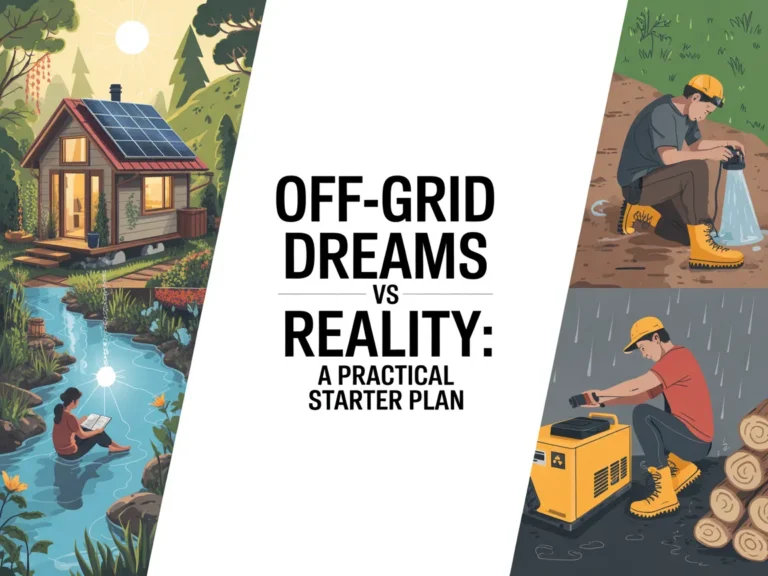
Living “off-grid” usually starts as a clean mental picture: quiet mornings, fewer bills, a simpler life… maybe a small cabin with a few solar panels and everything just works.
Then reality shows up.
You start Googling batteries, inverters, watts, panels, generators, permits, “DIY solar,” and a thousand conflicting opinions. Suddenly the dream feels technical, expensive, or like something only hardcore engineers can pull off.
This guide is here to calm that down.
One Big Idea: Basics first, upgrades second.
If you get the basics right, you can build an off-grid setup that feels stable and predictable—whether your goal is full-time self-sufficiency, a weekend cabin, or a backup plan for outages.
In this Off-Grid Dreams vs Reality: A Practical Starter Plan, you’ll learn:
- How to think about power needs without getting lost in jargon
- A simple step-by-step plan to start small and scale safely
- The common mistakes that make off-grid systems frustrating (and how to avoid them)
Next: a quick reality check so you know you’re not “behind.”
Quick Reality Check
Most people don’t struggle with off-grid living because they’re lazy or “not handy.”
They struggle because off-grid planning has too many options and too many opinions—and the loudest advice is often the most complicated.
A few common scenarios:
- You try to “estimate your power,” but every calculator seems to give a different answer
- You buy a piece of gear first (panel/battery/inverter) and then realize it doesn’t match the rest
- You aim for full off-grid independence immediately, get overwhelmed, and stall out
You’re not behind—you just need a simple plan.
The Core Framework
When off-grid planning feels messy, it helps to use a framework that stays true no matter what gear you choose.
1) What matters most (key variables)
There are a few variables that shape everything:
- Your daily energy use (what you actually run, not what you wish you could run)
- Your “critical loads” (what must stay on during an outage)
- Your location and sunlight (your system lives in the real world, not in a brochure)
- Your tolerance for complexity (simple setups get used; complicated setups get ignored)
2) The basics (core actions)
The basics are boring—but they’re what make off-grid life feel reliable:
- Reduce waste first
- Define must-have power
- Build a small system you can test
- Add capacity only after your numbers are real
3) The next layer (the upgrade people skip)
The next layer is where off-grid plans become resilient:
- Redundancy (backup methods)
- Storage and load management
- A clear expansion path (so upgrades don’t force a full rebuild)
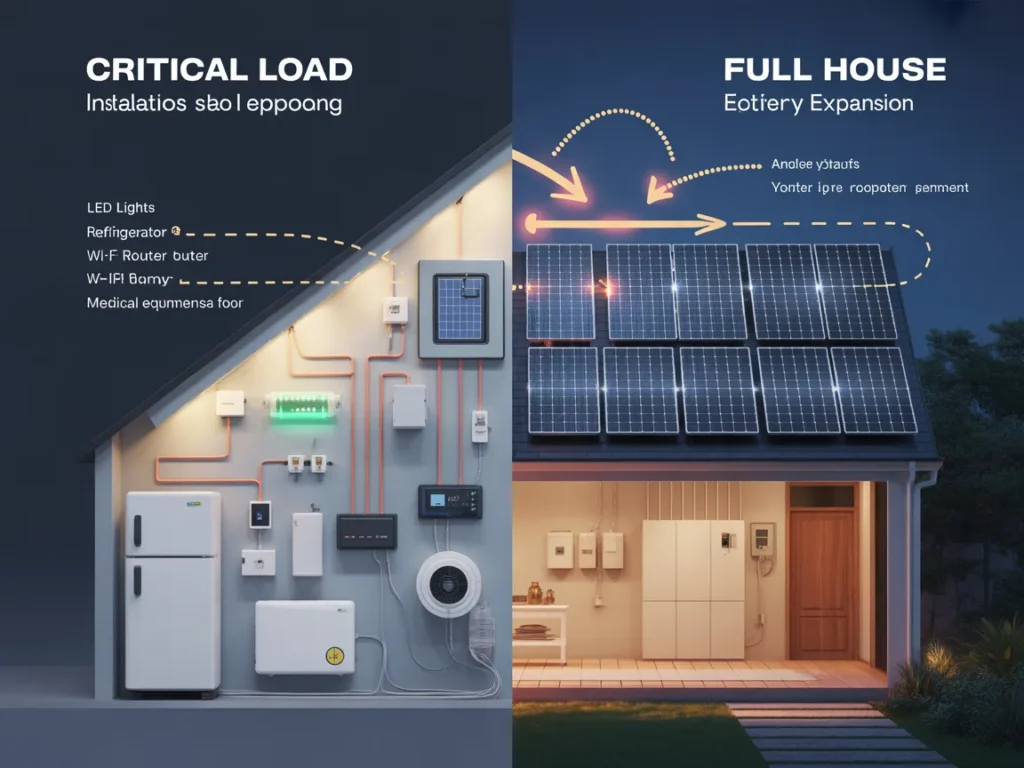
Example #1: Instead of building a “whole house off-grid solar” system immediately, you start with a critical-load circuit (lights, fridge, Wi‑Fi, medical devices), then expand.
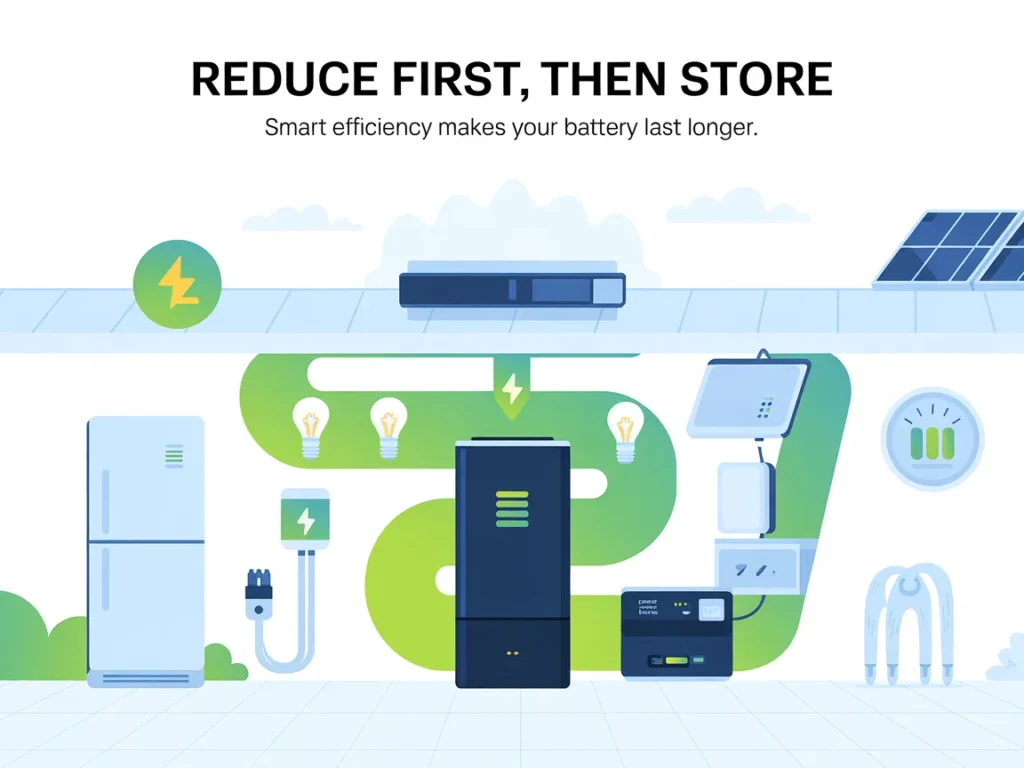
Example #2: Instead of buying the biggest battery you can afford, you first reduce standby loads and inefficient appliances—so your storage lasts longer.
Next: let’s turn that framework into a practical starter plan you can follow this week.
The Step-by-Step Plan
Step 1: Define your off-grid “why” and your non-negotiables
Off-grid has different meanings: full-time independence, partial solar, a backup power plan, a remote cabin setup, or just reducing reliance on the utility company.
If you don’t define the target, you’ll either overspend or build something that disappoints you.
Checklist:
- Decide your main purpose: backup power, weekend cabin, or full off-grid living
- List your top 5 critical loads (the things you truly want powered)
- Note any special requirements (medical devices, well pump, freezer, internet)
- Decide your comfort level: “simple + reliable” vs “maximum capacity”
- Choose a starting time horizon: 30 days (starter build), 90 days (upgrade phase)
Do this now: write down your top 5 critical loads on paper—don’t open a shopping tab yet.
Step 2: Do a simple energy audit (without getting lost)
You don’t need to be an engineer to estimate energy use. You just need a repeatable method and a willingness to measure a few real-world numbers.
This is where many off-grid dreams go sideways: people guess, then build a system around guesses.
Your goal is to get “good enough” numbers to start small… then refine.
Checklist:
- List each critical load and how many hours/day you run it
- Find wattage from labels (or manuals) for appliances and chargers
- Identify “always-on” loads (routers, standby devices, smart gadgets)
- Flag high-draw items (space heaters, AC, electric cooking, power tools)
- Decide what you will not power at first (this is key)
- If possible, measure a few items with a plug-in power meter
Do this now: pick one day and track what you actually use—real data beats perfect estimates.
Step 3: Build a starter system around critical loads
The fastest way to make off-grid feel real is to power something meaningful—reliably—without attempting to run everything.
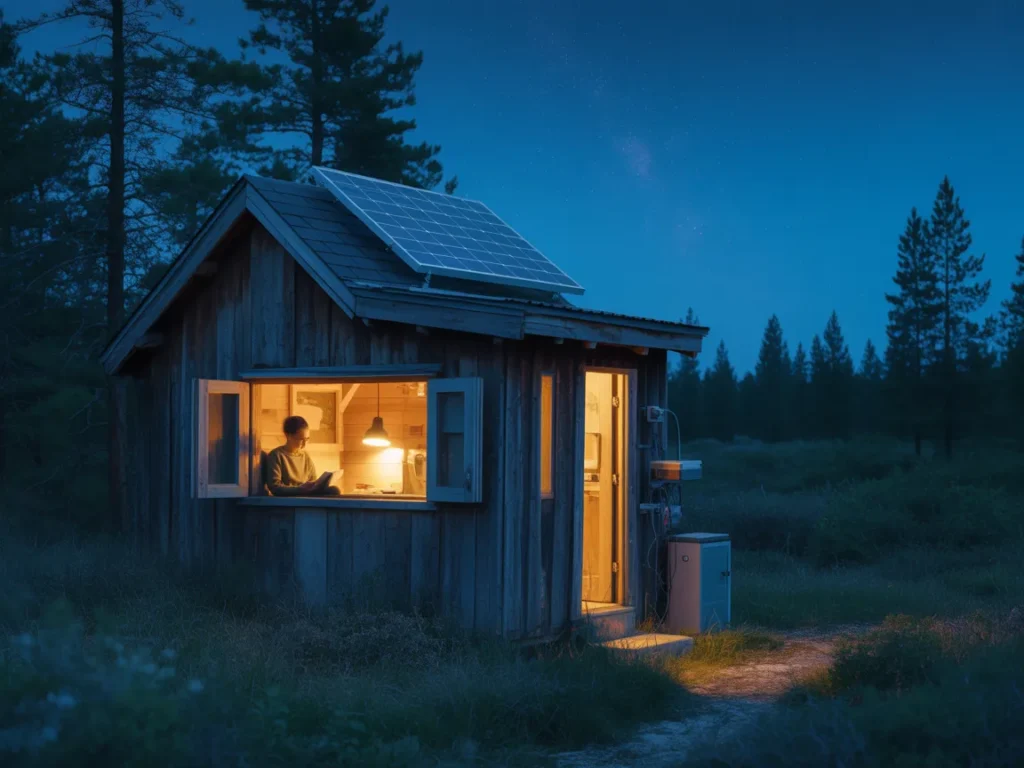
A starter system is not “settling.” It’s how you avoid expensive mismatches and learn what your household actually needs.
Think in terms of:
- A small solar power setup (or partial solar)
- A basic battery backup approach
- A limited set of circuits that you know you can support
Checklist:
- Choose your starter loads (example: fridge + lights + device charging)
- Decide if you want portable vs semi-permanent setup
- Plan for safe installation (especially if integrating with home wiring)
- Confirm ventilation and temperature needs for any batteries/gear
- Keep the system easy to test and monitor
- Set a goal: “Run critical loads for X hours and learn what breaks first”
Do this now: pick ONE “starter win” load (like your fridge or lighting) and design around that first.
Step 4: Reduce demand before you buy more supply
This is the least exciting step—and it saves the most money and stress.
Every watt you don’t waste is a watt you don’t have to generate, store, or manage. Off-grid living rewards efficiency. If you skip this, you’ll chase bigger panels and bigger batteries forever.
Checklist:
- Replace old bulbs with LEDs (if not already)
- Identify phantom loads and unplug/disable where possible
- Consider efficient cooking strategies (when off-grid)
- Evaluate your biggest energy hogs (heating/cooling especially)
- Improve insulation/weather sealing where practical
- Use scheduling: do heavy usage when power is available
Do this now: unplug or switch off two “always-on” devices you don’t truly need.
Step 5: Plan your upgrades in layers (so you don’t rebuild later)
Most people don’t fail off-grid because they “didn’t buy enough.” They fail because they bought the wrong thing first—and upgrades force a total do-over.
Layered planning means:
- Your starter setup works now
- Your next purchase fits the system later
- You can scale without throwing gear away
Checklist:
- Decide your next upgrade priority (more storage vs more generation)
- Write a simple expansion plan: “If we add X load, we need Y capacity”
- Plan for seasonal shifts (winter solar vs summer solar)
- Keep safety and reliability ahead of “max power”
- Document what you learn from real usage (hours, failures, surprises)
Do this now: write one sentence—“My next upgrade will be ___ because ___.”
Step 6 (optional): Create a calm outage routine
Even if you’re not fully off-grid, having a routine makes your system feel like a tool—not a science project.
Checklist:
- Decide what turns off first during an outage
- Store charging cables/flashlights in one place
- Keep a short checklist taped near the system
- Make sure basic communication stays powered
- Test the routine once a month (short test is fine)
Do this now: create a “power priority list” (must-have, nice-to-have, off).
Common Mistakes
Mistake 1: Trying to power the whole house immediately
Why it happens: It sounds efficient to “do it once,” but the first plan is rarely the final plan.
Simple fix: Start with critical loads, learn your real usage, then expand.
Mistake 2: Buying parts before defining the system
Why it happens: Shopping feels like progress, and gear is exciting.
Simple fix: Define your loads and your target runtime first, then choose components that match.
Mistake 3: Ignoring efficiency because it feels small
Why it happens: Upgrades like insulation and LEDs aren’t as fun as batteries and panels.
Simple fix: Reduce demand first; it makes every future upgrade cheaper and easier.
Mistake 4: Underestimating seasonal changes
Why it happens: Many plans assume consistent sunlight and temperature.
Simple fix: Treat winter as a different operating mode and plan for it.
Mistake 5: Overcomplicating the setup
Why it happens: Online forums reward complex builds and advanced jargon.
Simple fix: Choose reliability and simplicity—especially for your starter system.
Mistake 6: Not testing under real conditions
Why it happens: It’s easy to treat the plan as theoretical.
Simple fix: Run a weekend “practice mode” and note what fails or annoys you.
Options Comparison
Below are five common approaches people consider when turning Off-Grid Dreams vs Reality: A Practical Starter Plan into something real. None is “perfect”—each fits different goals.
Option 1: Partial off-grid (grid-tied lifestyle + reduced dependence)
Best for: Homeowners who want resilience and lower reliance without full independence.
Pros:
- Easier transition
- Less pressure to power everything
- Good for learning your real usage
Cons: - Still dependent on the grid in many situations
- May not satisfy “total self-sufficiency” goals
Option 2: Critical-load backup power (small system, high usefulness)
Best for: Emergency preparedness readers and budget-conscious households.
Pros:
- Focuses on what matters in outages
- Often simpler to manage
- Lower complexity and maintenance
Cons: - Doesn’t run large loads for long
- You must choose what stays off
Option 3: Full off-grid solar + storage (primary home power)
Best for: Off-grid lifestyle fans with stable energy needs and strong planning discipline.
Pros:
- True independence feeling
- Predictable daily routine once tuned
- Scales with careful planning
Cons: - Higher complexity
- Mistakes are expensive
- Seasonal constraints matter a lot
Option 4: Generator-first approach (with a plan to reduce reliance)
Best for: People in low-sun areas or those needing high surge power sometimes.
Pros:
- Straightforward “turn it on, get power”
- Handles bigger loads more easily
- Useful as redundancy
Cons: - Fuel logistics and noise
- Ongoing operating requirements
- Less “set and forget”
Option 5: DIY learning path (start small, build skills, then scale)
Best for: DIY enthusiasts and renewable-energy curious readers who want control.
Pros:
- You understand your system deeply
- Flexible and customizable
- Can start very small
Cons: - Research overload risk
- Easy to get stuck in planning
- Safety and compatibility require attention
Which option should you pick?
If you’re a homeowner who wants calm reliability, start with critical-load backup or partial off-grid. If you’re DIY-inclined, the DIY learning path can be great—just keep it simple and test often. If your time is limited, choose the approach that reduces complexity first, then expand as you learn.
Next: here’s a resource you can use to see a complete walkthrough without guessing.
Ressources
If you’ve been piecing together off-grid advice from videos, forums, and product pages, you’ve probably noticed the same problem: lots of information, not enough clear sequencing.
That’s why a structured walkthrough can be helpful—especially if you want to avoid buying mismatched components or overbuilding too soon.
The Energy Revolution System presentation is a practical next step to watch/read because it lays out an organized approach you can evaluate at your own pace.
You’ll see how it works, what’s included, and whether it fits your goals—without needing to commit to anything just to learn the process.
SEE THE FULL PRESENTATION HERE
Taking the next step is simply seeing the full walkthrough so you can compare it to your current plan and fill the gaps.
In the presentation, you’ll see:
- How the Energy Revolution System is structured as a guided system
- What the training/guide includes so you know what you’d be following
- The core idea behind the approach so you can decide if it matches your situation
Objection Handling FAQ
Beginner-friendliness and complexity
Is this beginner-friendly if I’m not technical?
If you can follow a step-by-step guide, you can evaluate whether the Energy Revolution System matches your comfort level. The presentation clarifies what’s involved so you’re not guessing.
Do I need special tools or advanced DIY skills?
The presentation explains the approach and what’s included, so you can see the expected level of hands-on work before deciding.
How long does it take to get started?
That depends on your goals (backup vs full off-grid). The presentation helps you map the process so you can start with a manageable first step.
Fit and practicality
Is this only for people living in remote cabins?
Many people exploring off-grid planning are homeowners who want resiliency and reduced dependence. The presentation helps you judge fit based on your situation.
What if I only want partial off-grid power, not total independence?
That’s a common, practical goal. Use the presentation to see whether the system supports a staged, scalable approach.
Will this help me avoid buying the wrong gear first?
A structured walkthrough can help you think in sequence—needs first, components second—so you reduce “trial and error.”
Budget and planning concerns (without shopping talk)
What if I’m trying to keep things simple and not overwhelm my family?
That’s exactly why a basics-first plan matters. The presentation is useful because it organizes the process so you can keep decisions calm and incremental.
What if I’m skeptical because off-grid info online is full of hype?
Healthy skepticism is smart. Watch/read the presentation simply to understand the method and decide whether it’s realistic for you.
Mini Summary + Action Plan
If you remember nothing else from Off-Grid Dreams vs Reality: A Practical Starter Plan, remember this: Basics first, upgrades second—that’s how off-grid becomes predictable.
Here’s your simple action plan:
- Define your off-grid purpose and top 5 critical loads
- Do a basic energy audit using real usage (not guesses)
- Build a starter system that powers something meaningful reliably
- Test your setup under real conditions at least once
- Track what drains power fastest and what surprises you
- Upgrade in layers so each addition fits the long-term plan
- Add redundancy and a calm outage routine as the next layer
Basics first creates clarity. Upgrades second creates resilience.
Conclusion
Off-grid living isn’t about being extreme or technical. It’s about being clear.
When you follow Off-Grid Dreams vs Reality: A Practical Starter Plan, you stop chasing the “perfect setup” and start building something you can actually use—one reliable layer at a time. That’s how your solar power goals (or backup power goals) turn into a calm routine instead of a stressful project.
If you want a guided walkthrough you can review at your own pace, the next step is simply to watch/read the Energy Revolution System presentation and decide whether the method fits your home, your goals, and your comfort level.
SEE THE FULL PRESENTATION HERE