Picture this: the tap still works today… but you’ve realized you don’t actually control your water access.
Maybe you’re on city water and you’ve watched boil notices pop up. Maybe you’re rural but drilling a well isn’t realistic. Or maybe you rent, live in an HOA, or simply can’t set up rain catchment without headaches.
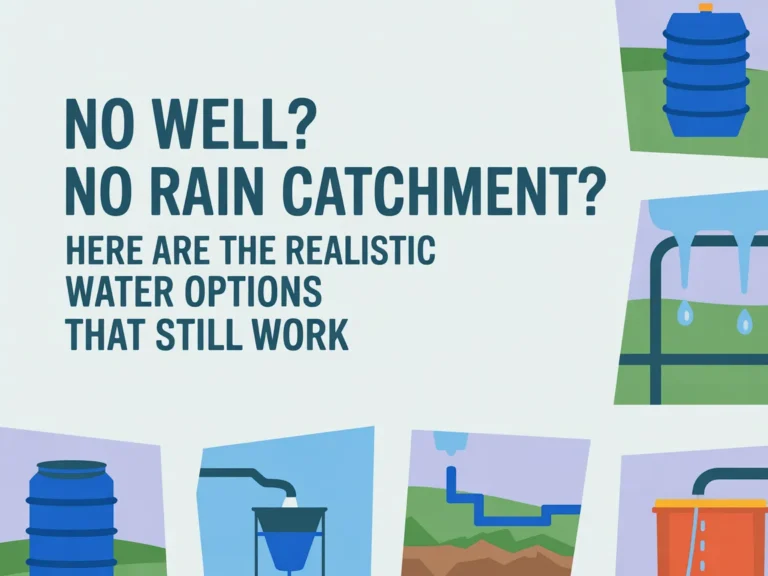
If you’ve been searching “No Well? No Rain Catchment? Here Are the Realistic Water Options That Still Work”, you’re not looking for fantasy solutions. You want options you can actually do—starting now—with the space, budget, and time you have.
Simple beats complicated.
In this guide, you’ll learn:
- The core variables that matter more than “which gadget to buy”
- A step-by-step way to build water resilience without wells or rain barrels
- A clear comparison of realistic water options (and who each one fits best)
Next: a quick reality check so you can stop second-guessing and start planning.
Quick Reality Check
This problem is common because most homes were designed around the assumption that “water will always be there.” When that assumption gets shaky, it’s easy to feel like you’re behind.
A few situations that tend to push people into action:
- You can’t install a well (cost, geology, permitting, rental rules)
- Rain catchment isn’t allowed or isn’t practical (space, roof access, HOA)
- You want a backup plan that doesn’t require major construction
The frustration is real—especially when online advice jumps straight to big systems or specialized gear.
You’re not behind—you just need a simple plan.
Next: the framework that makes the rest of your decisions easier.
The Core Framework
When you don’t have a well or rain catchment, the smartest approach is to stop looking for a single “perfect” solution—and instead build a plan around what matters.
Here’s a calm 3-part framework that keeps it simple.
What matters most (key variables)
Focus on the variables that determine whether a water plan actually works for your household:
- Daily water needs (drinking vs. cooking vs. hygiene)
- Storage capacity (where it can safely sit, and how much you can store)
- Treatment method (how you make water safer when the source is uncertain)
The basics (core actions)
Most people skip this and jump to gear. Don’t.
- Store an amount you can rotate
- Have a straightforward way to improve water quality
- Know your realistic sources when the usual one is unavailable
The “next layer” (the upgrade people skip)
The upgrade isn’t always “buy something bigger.” It’s usually:
- A repeatable routine
- A clear, written plan
- A household system everyone can follow without stress
Example: A family can store water in food-grade containers, rotate on a schedule, and use a simple treatment method for uncertain sources—without drilling, plumbing, or rooftop systems.
Example: An apartment household can rely on store-bought water plus a compact storage rotation plan—and still be far more prepared than most.
Next: turn this into a step-by-step checklist you can follow this week.
The Step-by-Step Plan
You don’t need to do everything at once. You just need to do the right basics first, then add one upgrade at a time.
Step 1: Define “use cases” (not just gallons)
Water planning gets messy when you treat water as one vague category. Instead, separate it into practical uses.
You’ll make better choices—and avoid wasting money—when you decide what you’re solving for.
Checklist
- Drinking water needs (per person)
- Cooking needs (simple meals vs. more involved)
- Basic hygiene needs (minimal vs. comfortable)
- Pet water needs (if applicable)
- A “temporary disruption” plan vs. “longer outage” plan
Do this now: Write down the top 3 water uses you refuse to be without.
Step 2: Choose a storage method you can actually rotate
Without a well or rain catchment, stored water becomes your foundation. The “best” container is the one you can store safely and rotate without dread.
Rotation matters because it keeps your plan usable and reduces the chance you ignore it for years.
Checklist
- Pick storage locations (cool, dry, out of direct sunlight)
- Select containers you can lift and pour safely
- Label containers with fill dates
- Store a basic pouring method (spout or funnel)
- Decide a simple rotation schedule you’ll keep
Do this now: Identify one storage spot and commit it to water only.
Step 3: Plan your realistic refill sources
If you can’t rely on a well or rain catchment, the question becomes: “Where will I get more water if I need it?”
This is where people either get overwhelmed—or they get smart and practical.
Potential sources depend on your location and rules, but the key is to pick sources you can access without special permissions.
Checklist
- Identify store-bought options you can reliably restock
- Map nearby sources you can reach quickly (if needed)
- Consider family/friends locations as part of your plan
- Keep containers ready for transport
- Write down “refill rules” (when you refill, how much, and how you store it)
Do this now: Make a short list of 2–3 refill sources that realistically apply to you.
Step 4: Add a straightforward way to improve water quality
If your only plan is “store bottled water,” you’ll be limited. If your plan includes a simple method to improve water quality, you become more flexible—even without a well or rain catchment.
Keep this beginner-friendly. The goal is a method you can use calmly.
Checklist
- Decide what “good enough” means for your household
- Pick a single treatment approach you understand
- Store what you need for that method in one place
- Practice using it once (so it’s not new during stress)
- Keep written instructions with your supplies
Do this now: Choose one treatment method and set it up so you can use it without guessing.
Step 5: Create a household routine so it doesn’t fall apart
Most water plans fail because they’re not integrated into normal life. A simple routine keeps it from becoming another abandoned project.
When life gets busy, routines win.
Checklist
- Pick a rotation day (monthly, quarterly—whatever you’ll keep)
- Assign one person to verify dates and container condition
- Keep a quick checklist near your storage area
- Update your refill source list as life changes
- Do one small “practice run” (pouring, moving, using your method)
Do this now: Put your rotation day on your calendar right now.
Step 6 (optional): Add comfort without complexity
Once the basics are stable, you can add comfort upgrades that don’t require construction.
Checklist
- Extra containers for easier handling
- A dedicated area for water supplies
- A simple “grab list” for refilling trips
- Better labeling and organization
- A backup method in case your primary approach isn’t available
Do this now: Pick one comfort upgrade that reduces stress, not one that creates another project.
Common Mistakes
Trying to engineer the “perfect” system immediately
Why it happens: You want certainty, so you over-research and freeze.
Simple fix: Build the basics first (storage + rotation + one treatment method), then upgrade.Storing water but never rotating it
Why it happens: It feels like a “set it and forget it” task.
Simple fix: Tie rotation to a calendar reminder and keep labels visible.Choosing containers that are too heavy or awkward
Why it happens: Bigger sounds better until you have to lift it.
Simple fix: Use sizes you can move safely and consistently.Relying on one refill source
Why it happens: It’s easier to plan around a single option.
Simple fix: Keep at least two realistic refill sources written down.Having supplies but no simple instructions
Why it happens: You assume you’ll remember how everything works.
Simple fix: Keep a one-page “how we do water” sheet with your supplies.Ignoring household reality (kids, pets, schedules)
Why it happens: Plans are made in quiet moments, not real life.
Simple fix: Build around your actual routines and make it easy to follow.
Options Comparison
Below are realistic approaches when the headline is your reality: No Well? No Rain Catchment? Here Are the Realistic Water Options That Still Work. None are perfect. Each can work—if you match it to your situation.
Option 1: Store-bought water + rotation system
Best for: Families, renters, busy households, anyone who wants the simplest start
Pros
- Easy to start with minimal planning
- Predictable quality (when purchased from a standard source)
- No setup with plumbing, roofs, or permitting
Cons
- Restocking depends on availability
- Requires storage space
- Needs rotation discipline
Option 2: Stored tap water in food-safe containers + rotation
Best for: Homeowners and families who want affordability and control
Pros
- Cost-effective compared to exclusively buying bottled water
- Lets you store more volume in less packaging
- Works without wells or rain catchment
Cons
- Requires labeling and rotation
- Container choice matters (safety + usability)
- Still relies on the tap being available during refill times
Option 3: Alternative refill strategy (transport + storage plan)
Best for: People who can access other locations (friends/family), or who can transport water
Pros
- Adds flexibility without construction
- Can work even if your normal supply is disrupted
- Scales up or down based on your vehicle/storage
Cons
- Requires planning and logistics
- Not ideal if you can’t transport safely
- Depends on access to the refill location
Option 4: Treatment capability for uncertain sources
Best for: Self-sufficiency seekers who want more “what-if” coverage
Pros
- Expands the types of water you can potentially use
- Pairs well with storage and transport plans
- Builds confidence through capability, not luck
Cons
- Requires correct use and basic practice
- Needs supplies kept together and maintained
- Not a replacement for storage—better as a layer
Option 5: Community-based planning (mutual aid + redundancy)
Best for: Families and neighborhoods that can coordinate calmly
Pros
- Reduces the pressure on one household
- Helps share tools, knowledge, and transport
- Encourages realistic planning instead of isolated panic
Cons
- Coordination can be inconsistent
- Requires clear expectations
- Not fully “in your control”
Which option should you pick?
If you’re a family or busy homeowner, start with storage + rotation, because it’s the most reliable foundation with the least complexity. If your budget is tight, lean into stored tap water in proper containers and a strict rotation routine. If you’re more self-sufficiency-minded, add treatment capability as your next layer so you’re not boxed into one source. Simple beats complicated—especially when you’re building something you’ll actually maintain.
Next: a practical resource that can help you see a complete walkthrough without piecing it together from random advice.
Resources
If you’ve ever felt like water planning advice is either “just buy a bunch of stuff” or “build an off-grid system,” you’re not alone.
What helps is a clear walkthrough that shows you a complete approach—what to do first, how the pieces fit together, and how to avoid overcomplicating it.
There’s a presentation for WaterSmartBox that lays out a system in a more structured way than most scattered blog posts. Even if you don’t end up using it, it can give you a clearer mental model for building your own plan.
You’ll see how it works, what’s included, and whether it fits you.
SEE THE FULL PRESENTATION HERE
If you want a more guided explanation you can follow without bouncing between conflicting advice, the WaterSmartBox presentation is a logical next step.
In the presentation, you’ll see:
- How the WaterSmartBox approach is explained step-by-step
- What’s included in the WaterSmartBox system
- How it’s meant to help you think through water preparedness in a structured way
FAQ
Fit and practicality for families
Is this beginner-friendly if I’m starting from zero?
Yes—if you focus on basics first. The goal is a simple plan you can actually maintain, then expand from there.
Do I need special tools or a complicated setup?
Not to start. Most households can begin with storage, labeling, and a simple routine before adding any upgrades.
How much time does it take to get a basic plan in place?
You can map your uses, choose storage, and set a rotation routine in a single afternoon—then build from there.
Space, budget, and daily life
What if I live in a smaller home or apartment?
Small-space plans work well when you prioritize manageable containers and a rotation schedule you’ll follow.
What if my budget is tight right now?
A basics-first approach helps you avoid wasted purchases. Start with what you can store and rotate reliably.
What if I can’t carry heavy containers?
Choose smaller, easier-to-handle containers and build capacity through multiples, not weight.
Complexity and confidence
How do I know which water option is “right” for my household?
Match it to your constraints: space, time, and what you can maintain calmly. Consistency matters more than intensity.
If I watch the presentation, do I have to commit to anything?
No. You can watch to understand the approach and decide whether it fits your situation.
Mini Summary + Action Plan
Store water in a way you can safely access and actually rotate
Separate water needs into practical uses (drinking, cooking, hygiene)
Write down 2–3 realistic refill sources you can count on
Put rotation on a calendar so the plan stays alive
Keep labels, containers, and instructions organized in one place
Add one simple method to improve water quality as your “next layer”
Upgrade comfort and redundancy only after the basics are stable
Simple beats complicated—because simple is what you’ll maintain.
Conclusion
If you’ve been stuck in the loop of searching “No Well? No Rain Catchment? Here Are the Realistic Water Options That Still Work”, the most important shift is this: you don’t need a perfect system—you need a plan you’ll follow.
When your storage is organized, your rotation is scheduled, and your refill options are realistic, you stop guessing. You stop feeling like you’re one surprise away from scrambling.
And you can picture it clearly: a normal week, a minor disruption, and you’re calm because you already know what to do next.
If you want to see a structured walkthrough instead of piecing everything together from random advice, take a look at the WaterSmartBox presentation here:
SEE THE FULL PRESENTATION HEREDisclaimer: This article is for general educational purposes only and is not professional safety, health, or legal advice. Always follow local rules and official guidance for water safety and storage.